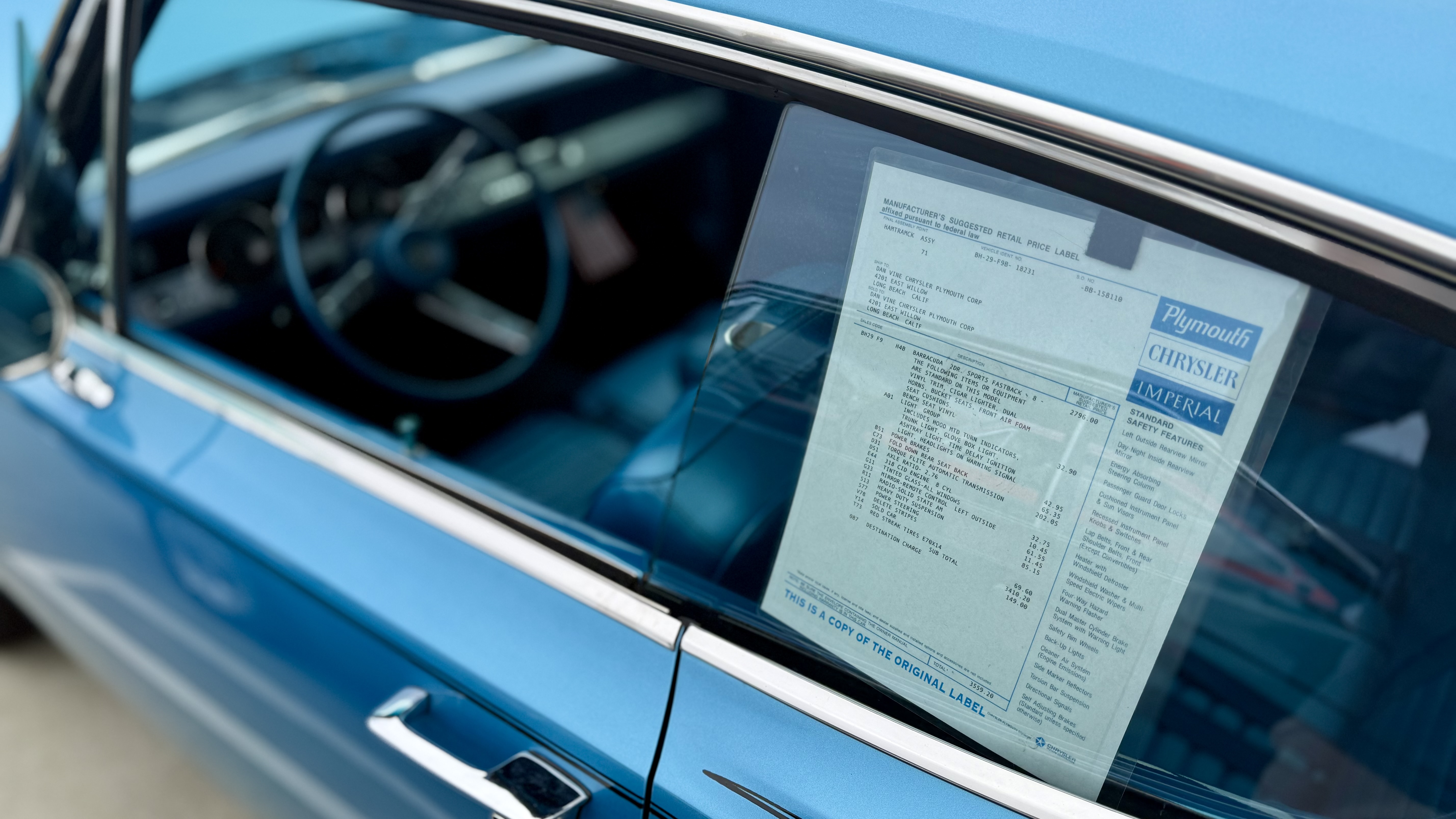
A displayed window sticker adds configuration and documentary context to this 1969 Plymouth Barracuda.
Learn which parts of a classic vehicle’s original identity its VIN may establish, what it cannot prove, and which additional records complete the picture.
A classic-car VIN can establish important pieces of a vehicle’s original identity, but it is not a universal build sheet.
What the VIN reveals depends on the manufacturer, division, model, year, assembly system, and market. One VIN may identify an original engine category and performance series. Another may reveal little more than the model family, body style, assembly plant, and production sequence.
Decode only what the VIN actually proves. Use trim tags, fender tags, component stampings, factory documents, and ownership records for everything else.
A VIN is primarily an identity number. Depending on the system, it may also encode selected characteristics such as car line, body style, year, assembly plant, or engine family.
It should not automatically be treated as a complete description of how the vehicle left the factory. Paint, interior, transmission, axle, optional equipment, package content, and dealer additions may appear only in separate records.
Even two vehicles built by the same corporate manufacturer can use VIN systems that reveal different information.
The familiar standardized 17-character VIN belongs mainly to the 1981-and-newer era. Earlier manufacturers used their own character lengths, sequences, abbreviations, and coding rules.
A legitimate classic identifier may contain fewer than 17 characters. It may be called a VIN, serial number, chassis number, vehicle number, or another manufacturer-specific term.
Do not add zeros, remove prefixes, or alter an older identifier to make it resemble a modern VIN. Record it exactly as it appears on the vehicle and its title.
Use the Classic Car VIN Location Reference to find common identifier locations and expected lengths by year, make, and model.
Many Chrysler Corporation VIN systems from the muscle-car era encode a car line, price class, body style, engine category, model year, assembly plant, and production sequence.
That makes some Mopar VINs unusually informative, but it does not mean every option, drivetrain component, or special package is encoded.
These examples show why the original VIN and the vehicle’s current appearance must be evaluated separately.
The VIN on this 1968 Plymouth Road Runner identifies the Road Runner series, body configuration, original engine category, model year, assembly plant, and production sequence.
The VIN on this 1969 Plymouth Barracuda identifies an original 318-cubic-inch engine category. A later 440 air-cleaner display does not change what the VIN says the vehicle was built with.
The VIN on this 1970 Dodge Challenger R/T convertible identifies an original 383 engine category. Shaker equipment, badges, or a different engine shown in the documented event appearance require separate evidence.
No. The amount of information depends on the exact year and VIN system. A muscle-era Mopar VIN may encode an engine category and price class, but that is not the same as documenting every factory option or proving that the installed drivetrain is original.
Fender tags and broadcast sheets often preserve configuration details that are not contained in the VIN. Engine and transmission stampings are still needed for many matching-numbers claims.
It is also inaccurate to say that classic GM VINs never identify engines, performance models, or trim. Chevrolet, Pontiac, Buick, Oldsmobile, and Cadillac used different systems, and those systems changed over time.
The correct question is not “What does a GM VIN reveal?” It is “What does this division’s VIN reveal for this model and year?”
Similar-looking VINs can carry very different levels of detail.
The VIN on this 1969 Chevrolet Camaro identifies the Camaro V8 series, coupe body, model year, assembly plant, and production sequence.
It does not by itself prove SS, RS, Z/28, COPO, the exact original V8, transmission, paint, interior, or full option content.
The VIN on this 1969 Pontiac GTO identifies it as a GTO rather than merely a similar Pontiac body.
The VIN does not prove that it is a Judge. Its window sticker and other supporting records document that additional package.
The VIN on this 1979 Pontiac Firebird Trans Am identifies the Trans Am series and an original 403-cubic-inch engine category.
This demonstrates why one GM VIN can reveal information that another GM VIN does not.
A model name alone is not enough to select the correct decoding rules. Chevrolet Chevelle series codes changed in significance across model years, and a code associated with an SS in one period should not automatically be interpreted the same way in another.
Corvair VINs are another example of why generic databases can be misleading. A decoder built around more familiar Chevrolet passenger-car rules may misread a Corvair-specific series or body code.
Always use documentation written for the exact division, model, and year.
Many classic Ford VINs identify the model year, assembly plant, body or model code, engine category, and production sequence.
A separate warranty or data plate may add body, color, trim, build-date, axle, and transmission information. Those data-plate codes should not be blended into the VIN decode as though they came from one identifier.
The VIN establishes the vehicle identity, while the data plate may describe additional factory configuration.
The VIN on this 1956 Ford Thunderbird encodes an engine category, model year, assembly plant, Thunderbird model code, and production sequence.
The VIN on this 1965 Ford Falcon Ranchero identifies the year, plant, Ranchero model code, engine category, and sequence.
Its separate data-plate body code provides more specific body and trim context.
An engine-coded VIN describes the engine category associated with the vehicle when it was built. It does not guarantee that the same engine block is still installed.
Engines, transmissions, hoods, badges, interior pieces, wheels, and complete bodies can be changed during decades of use and restoration.
When the vehicle’s current appearance conflicts with its VIN, document both facts accurately: what the VIN establishes about the original identity and what is installed or displayed now.
These claims normally require additional physical evidence or historical documentation.
Compare vehicle, engine, transmission, chassis, and other relevant stampings using model-specific procedures.
SS, RS, Z/28, Judge, special-order, and similar packages may require factory records, tags, or physical evidence.
Paint, trim, axle, transmission, accessories, and option content may appear on another tag or factory document.
Each source answers a different question. None should automatically be treated as a substitute for all the others.
May document body details, paint, interior, scheduled build date, options, or plant-specific information.
May preserve the vehicle’s planned factory configuration and assembly instructions.
May document equipment, pricing, destination, dealer information, and optional packages.
Engine, transmission, frame, and body stampings may help establish dates, applications, or a relationship to the VIN.
Archives, clubs, and model registries may preserve information never encoded in the VIN.
Titles, registrations, insurance documents, photographs, and bills of sale establish where the vehicle was and who cared for it.
A window sticker may document equipment, pricing, colors, options, destination information, or the selling dealer. Those details may be essential when the VIN identifies only the broader vehicle series and drivetrain category.
This 1969 Plymouth Barracuda is displayed with a window sticker that adds configuration and documentary context beyond its VIN.
People often use VIN as a general term for any identifying number found on an older vehicle. Manufacturers may instead use terms such as chassis number, serial number, vehicle number, or patent plate.
A body number, trim-tag number, engine number, or component casting number may be important without being the primary identifier used on the title.
Before creating a vehicle record, confirm which number legally and historically identifies the vehicle itself.
Modern VIN decoders are built around the standardized 17-character system and can work very well for newer vehicles. That does not mean they understand manufacturer-specific identifiers from the 1950s, 1960s, or 1970s.
A generic decoder may reject a valid short VIN, assign modern character positions to an older format, confuse a model-specific code, or return a plausible but incorrect result.
Conflicting results may also come from a mistyped character, confusion between zero and O or one and I, a replacement tag, a midyear change, or a number that was never the vehicle’s primary VIN.
A decoder cannot provide the complete ownership history, restorations, races, awards, auctions, event appearances, museum displays, sightings, photographs, or personal memories connected to a vehicle.
Auto Lineage uses the VIN or older serial number as the identity anchor. Owners, organizers, photographers, historians, and enthusiasts can then preserve documented moments on one shared vehicle profile over time.
Explore documented vehicle lineage to see the types of history an identifier cannot encode.
Search for the exact vehicle on Auto Lineage, then add the documents, photographs, ownership periods, and lineage that explain what the identifier alone cannot.
Explore more guides for vehicle history and automotive events.
Discover why vehicle stories matter and how the car community can help preserve them.
Learn how to preserve records, photographs, milestones, ownership periods, and context.
Organize the vehicle’s identity, ownership history, restoration records, photographs, and other history before ownership changes.
Learn how to search for a lost vehicle from your past, preserve what you know, and receive updates if new history is added later.
Search pre-1981 VIN and serial-number locations by year, make, model, identifier length, and important exceptions.