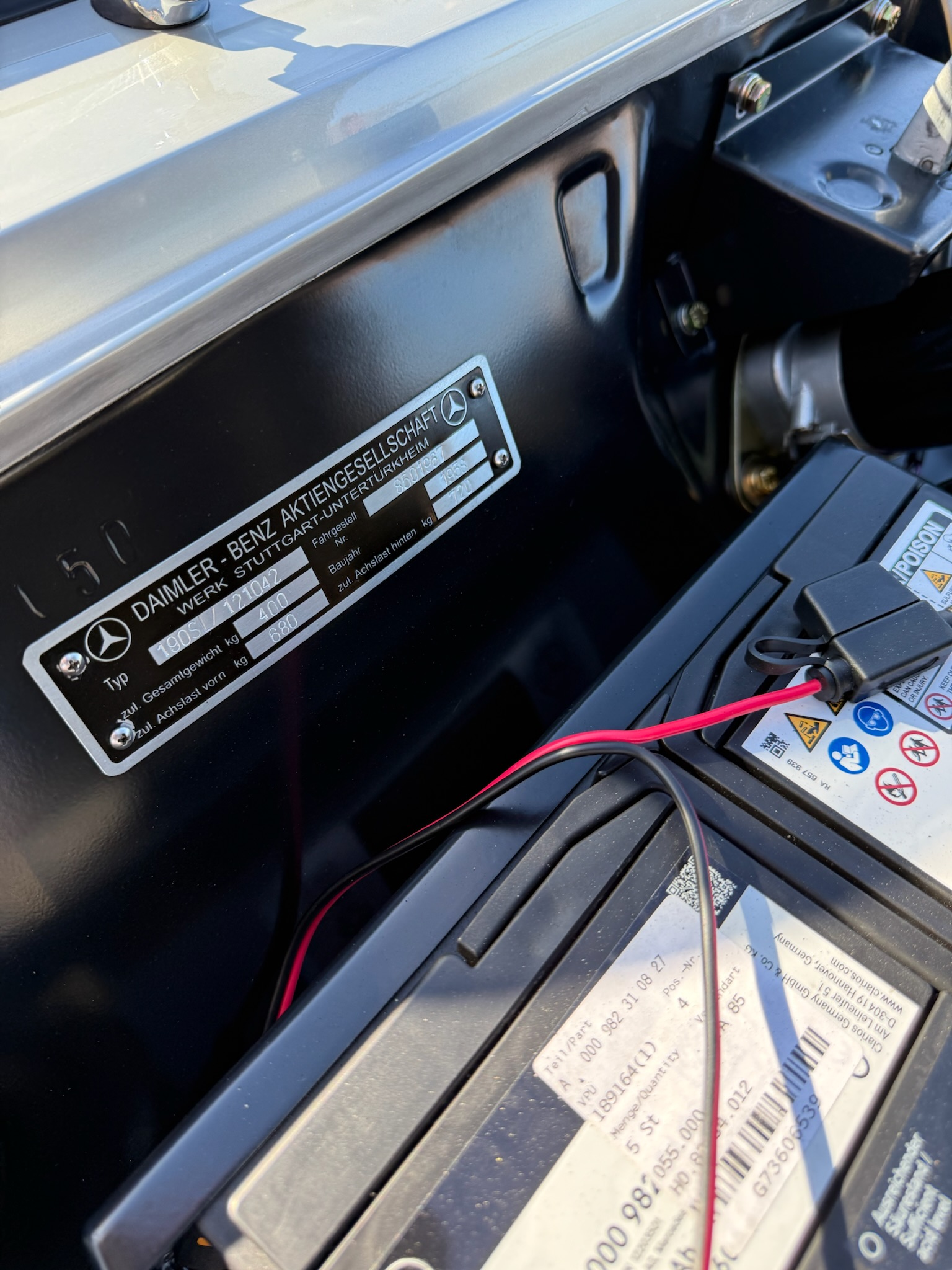
Manufacturer identification plate in the engine compartment of a 1958 Mercedes-Benz 190 SL.
Search this growing pre-1981 reference by year, make, model, and primary VIN or serial-number location.
Classic-car VINs and serial numbers were not standardized across manufacturers. Depending on the vehicle, the primary identifier may be visible through the windshield, mounted to a door hinge pillar, attached inside the engine compartment, or stamped into the frame.
This reference focuses on vehicles from 1980 and earlier. For most 1981-and-newer passenger vehicles, begin by checking the driver-side dashboard through the windshield and the driver-door certification label.
The table is a growing Auto Lineage research resource. Its rows are based on direct vehicle observations and model-specific references, but production changes, export vehicles, replacement bodies, and restorations can create exceptions.
Search by vehicle or filter the current verified reference entries. Select a column heading to change the sort order.
| Years | Make ↓ | Model | Primary Location | Notes | Length | Identifier |
|---|---|---|---|---|---|---|
| 1968–1971 | Pontiac | GTO | Driver-side dash | For this range, the vehicle identification plate is on the upper-left instrument panel. Earlier GTOs used the left front body hinge pillar. | 13 | VIN |
| 1968–1980 | Pontiac | Firebird | Driver-side dash | Beginning with 1968, the Firebird VIN moved to the upper driver-side dashboard. VINs from this range predate the standardized 17-character format introduced for 1981. | 13 | VIN |
| 1967 | Pontiac | Firebird | Driver door / jamb | The VIN plate is attached to the left door-hinge pillar. Beginning with 1968, the Firebird VIN moved to the upper driver-side dashboard. | 13 | VIN |
| 1968–1980 | Plymouth | Road Runner | Driver-side dash | In later years, the Road Runner became an option or package within other Plymouth model lines rather than remaining a separate model line. | 13 | VIN |
| 1969–1974 | Plymouth | Barracuda | Driver-side dash | — | 13 | VIN |
| 1955–1963 | Mercedes-Benz | 190 SL | Engine compartment | The chassis-number plate location applies across the 1955–1963 model range. Identifier presentation and formatting should be compared with the complete chassis number shown on the vehicle and its records. | Varies | Chassis number |
| 1955–1957 | Ford | Thunderbird | Engine compartment | The identification-plate style changed during the 1957 model year, but the general firewall location remained the same. | 10 | VIN / serial number |
| 1969–1980 | Ford | Mustang | Driver-side dash | Beginning in 1969, the Mustang VIN plate moved to the driver-side dashboard location. | 11 | VIN |
| 1968 | Ford | Mustang | Other | The 1968 Mustang is an important exception because the windshield-visible VIN plate is on the passenger side rather than the driver side. | 11 | VIN |
| 1965–1967 | Ford | Mustang | Engine compartment | A warranty or data plate may also appear on the driver-side door, but the stamped apron number is the primary body identification reference. | 11 | VIN |
| 1928–1931 | Ford | Model A | Frame / chassis | The same serial number was originally stamped on the engine. Restored, reconstructed, or state-titled vehicles may also carry an added firewall identification plate matching the title or registration. | 8 | Serial number |
| 1964–1965 | Ford | Falcon Ranchero | Engine compartment | Ford shop literature identifies the left front fender apron as the official VIN location for title and registration purposes. The separate door warranty plate should not automatically be treated as the official stamped VIN. | 11 | VIN |
| 1968–1978 | Dodge | Charger | Driver-side dash | Beginning in 1969, federal rules required the passenger-car VIN to be visible through the windshield near the left pillar. | 13 | VIN |
| 1970–1974 | Dodge | Challenger | Driver-side dash | — | 13 | VIN |
| 1972 | De Tomaso | Pantera | Driver-side dash | This pre-1981 identifier is shorter than a modern standardized 17-character VIN. | 11 | VIN / serial number |
The standardized 17-character VIN became the normal United States format for 1981-model vehicles. Earlier manufacturers used their own lengths, character meanings, and terminology.
A pre-1981 identifier may contain seven, eight, ten, eleven, twelve, thirteen, or another number of characters and still be legitimate. Length alone does not determine whether a classic-car VIN is valid.
An older vehicle may also have a body number, engine number, trim tag, fender tag, warranty plate, or chassis stamping. Those identifiers may be useful without serving as the primary number on the title.
Before 1981, VIN formats were manufacturer-specific. Even vehicles from the same manufacturer could use different lengths in different years or model lines.
Some ranges in the table show two possible lengths because an engine or series prefix adds a character. Others are marked “Varies” when a single reliable length should not be generalized across the full production range.
Record the identifier exactly as shown. Do not add leading zeros, remove manufacturer prefixes, or force a classic identifier into a 17-character format.
After locating the identifier, read What Can a Classic-Car VIN Tell You? to understand which facts the VIN may establish and which require other tags, stampings, or records.
This plate on a 1958 Mercedes-Benz 190 SL demonstrates how an older European vehicle may use chassis-number terminology and display several specifications in one place.
A visible number is not automatically the primary vehicle identifier. Identify the purpose of each field and compare it with the title or other reliable documentation.
Check old titles, registrations, insurance cards, loan records, bills of sale, repair invoices, dealership paperwork, classified advertisements, emails, restoration records, and family photographs.
A photograph may show a windshield plate, door-jamb plate, former license plate, dealership frame, or document containing the identifier. Remove private information before sharing documents publicly.
Once recovered, use How to Find a Lost Classic Car by VIN to continue the search.
Text recognition can help, but every character still needs to be checked against the original plate or stamping.
Capture one close, straight photograph of the complete number and one wider image showing its physical location.
Phone camera and photo apps may recognize text from a plate or stamping. Treat the result as a draft transcription.
Compare the result with the image. Watch especially for 0 and O, 1 and I, 5 and S, and 8 and B.
Several different numbers can appear on one classic vehicle.
A trim, cowl, or fender tag may describe paint, interior, build date, or options without being the primary vehicle identifier.
An engine or transmission stamping may help establish authenticity, but it is not automatically the number used on the title.
Restored, reconstructed, customized, or state-titled vehicles may carry replacement or added identification plates.
Adjacent model years can use different locations. The 1968 Mustang passenger-side dashboard placement is a useful example.
Search Auto Lineage first. If the exact vehicle does not already have a profile, add it and begin preserving its history.
Explore more guides for vehicle history and automotive events.
Discover why vehicle stories matter and how the car community can help preserve them.
Learn how to preserve records, photographs, milestones, ownership periods, and context.
Organize the vehicle’s identity, ownership history, restoration records, photographs, and other history before ownership changes.
Learn how to search for a lost vehicle from your past, preserve what you know, and receive updates if new history is added later.
Learn what an older VIN may establish and which claims require tags, stampings, factory documents, or other records.